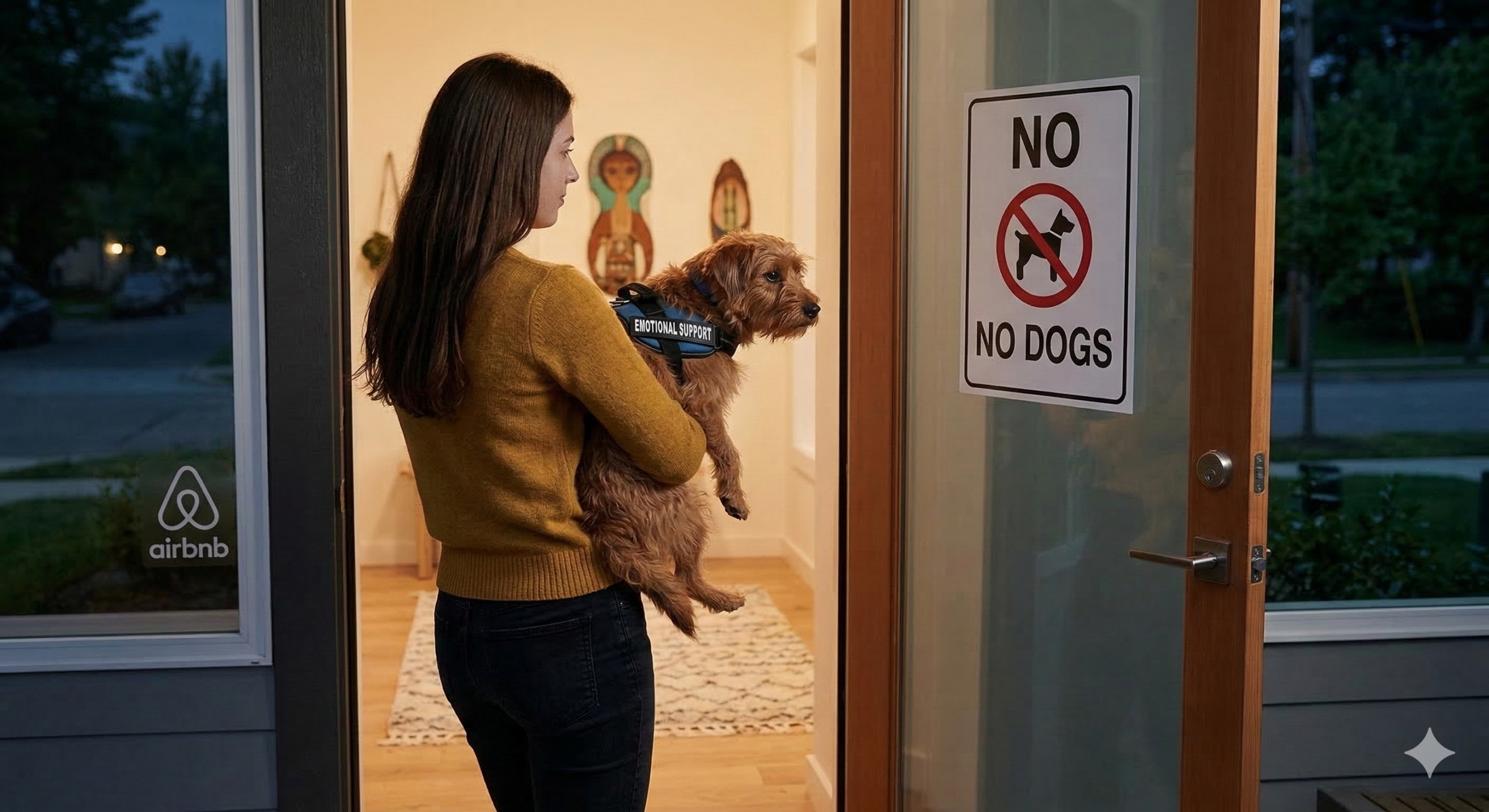
What every STR host and property manager needs to know about pets, fees, and the rules that actually protect your property.
You’ve made your decision. No pets. Policy set, listing updated, done.
Except it’s not that simple.
Service animals aren’t pets under the law — and if you treat them that way, Airbnb can remove your listing under their discrimination policy. That applies whether you’ve opted into pets or not.
At Corzly, our team has managed properties across 40+ cities and hosted over 60,000 guests. The pet conversation comes up constantly, and the hosts who think they’ve fully opted out of it are often the ones most caught off guard when a guest shows up at the door with a dog.
So whether you’re firmly in the no-pet camp, sitting on the fence, or ready to turn that filter on — here’s what you actually need to know.
Visibility
Go to Airbnb right now and pull up your market, hit the pet filter, and watch what happens.
In most markets, 50 to 70% of listings disappear. You’re suddenly competing against a much smaller pool of properties — and you’re visible to every traveler who won’t book without their dog.
Our team sees this across dozens of markets regularly. In a destination like Destin, Florida, that can mean dropping from over 1,000 listings down to under 500. If you’re one of those 500, you’re in a very different position than you were five minutes ago.
That doesn’t mean every host should allow pets. But the visibility opportunity is real, and most hosts in most markets are leaving it on the table.
How to Structure Pet Fees Across Each OTA
If you decide to allow pets, how you charge for them depends on the platform. Each OTA handles this a little differently.
1) Airbnb
Airbnb allows a flat pet fee, but it can’t exceed your average daily rate. If you’re charging $100 a night, you can’t set a $300 pet fee.
The workaround: put a per-pet, per-night fee in your house rules and collect the difference through the resolution center. Your guest accepts the terms at booking, so you have a clear paper trail.
2) VRBO
More flexibility here. You can charge per stay, per pet, or per night — whichever works best for your setup and your market.
3) Booking.com
If you’re collecting payments directly, you can handle the pet fee through your rental agreement. Put the terms in writing there and you’re covered.
One thing worth keeping in mind: pet fees add to the total reservation price guests see. In competitive markets, that matters. A refundable deposit, on the other hand, doesn’t show up in that total — which means you get the protection without affecting how your nightly rate looks in search results.
The Rules That Actually Protect You
Allowing pets without clear policies in place is where things go wrong. From our experience, here’s a solid starting point:
-
Size and breed restrictions (tied to your insurance policy — more on that below)
-
Maximum of two pets
-
No pets on furniture
-
No leaving pets home alone unless crated
-
Full disclosure at the time of booking — all pets must be added to the reservation
-
A per-pet fee applied at booking or through the resolution center
These go in your house rules on Airbnb. On every other platform, they belong in your rental agreement. Either way, get them in writing before you flip that filter on.
One more thing worth adding: a camera at your property entrance. If a guest told you they were showing up with one small dog and four Great Danes walk through the door, you want to know about it before checkout.
Check Your Insurance Before Anything Else
Some short-term rental insurance policies exclude pet damage entirely. Some have breed restrictions. And most policies are long enough that it’s easy to miss the relevant language.
Here’s a quick approach our team recommends: download your policy PDF, drop it into ChatGPT, and ask it to pull any language that restricts or excludes pets staying at your property. It takes about five minutes and could save you a serious headache down the road.
If your current policy doesn’t cover pets, that’s a conversation to have with your insurer before you start accepting bookings with animals.
Service Animals vs. Emotional Support Animals: Know the Difference
This is the part most hosts don’t fully understand — and it’s the part that can get your listing removed.
Service Animals
Under Airbnb’s policies, service animals are not pets. You cannot charge a pet fee. You cannot require documentation. You cannot ask for certification.
There are only two questions you’re allowed to ask:
-
Is this service animal required because of a disability?
-
What service task has the animal been trained to perform?
If you deny a guest with a service animal — or ask questions beyond those two — Airbnb can take your listing down under their discrimination policy. That applies even if you don’t allow pets on your listing.
And it’s not just dogs. Under Airbnb’s current policies, a service animal could be a cat, a rabbit, or even a small horse. There are no breed or species restrictions.
Emotional Support Animals (ESAs)
This is where you do have some flexibility. With an emotional support animal, you can ask questions, apply your standard pet policies, and charge your normal pet fee.
One important exception: if your property is in New York or California, emotional support animals are treated the same as service animals under state law. Same rules apply.
And regardless of the animal type — service animal or ESA — if there’s damage to your property, you still have the right to charge for it.
Marketing Your Pet-Friendly Property
If you’re allowing pets, don’t just flip the filter and call it done. The hosts seeing the best results are actively marketing it.
-
Add photos with pets in your listing
-
Include pet amenities — food bowls, waste bags, a leash hook by the door
-
Add the nearest dog park to your local area guide
-
Put together a small pet welcome basket
These are small touches that show up in reviews and keep guests coming back. Pet owners are a loyal segment — they travel with their animals regularly and they actively look for hosts who make the experience easy.
A Quick Recap Before You Decide
Whether you’re turning on the pet filter or holding firm on your current policy, here’s what our team recommends working through:
-
Check your market data — how many listings disappear when the pet filter is applied?
-
Talk to your housekeeper — make sure they’re comfortable and compensated appropriately for pet stays
-
Look at your comp set — are top-performing properties in your market allowing pets?
-
Get your rules in writing before you accept your first pet booking
-
Review your insurance policy for any pet exclusions
-
Make sure you and your team understand the difference between service animals and ESAs
The pet policy question affects every property in your portfolio, whether you’ve made a decision yet or not. Getting clear on the rules and the opportunity now puts you in a much better position either way.
Want help thinking through your pet policy across your portfolio?
Our team has managed properties across 40+ cities and worked through this exact decision hundreds of times. We’d be glad to walk you through it.
Visit corzly.com to get started.